


:quality(80)/p7i.vogel.de/wcms/2f/f3/2ff3221bf7665de2d0acf83760bfd1fa/0130031523v2.jpeg "Wolfspeed presents a 300 mm silicon carbide technology platform designed to support advanced packaging and high-efficiency power delivery for AI data center infrastructure. (Source: Wolfspeed)")
:quality(80)/p7i.vogel.de/wcms/c3/16/c316e955a97f5d72d9678297b237b9e5/0129932858v2.jpeg "Left: the single-phase version of the SENTRON ECPD with RCM, right: a model of the future three-phase version of the SENTRON ECPD. (Source: Siemens)")
:quality(80)/p7i.vogel.de/wcms/ef/0a/ef0adb0acf793fe147cc27c21f6a7a67/0129954238v2.jpeg "Empower Semiconductor introduces embedded silicon capacitors designed to improve power delivery and stability in AI and high-performance computing processors. (symbolic image) (Source: © IF.arc - stock.adobe.com)")
:quality(80)/p7i.vogel.de/wcms/53/f9/53f9301dfc9292d02960f7996c79cc6e/0129927601v2.jpeg "Wolfspeed’s new 10 kV SiC MOSFET enables high-voltage power conversion for grid and industrial applications. (symbolic image) (Source: © CREATIVE- 3.4 - stock.adobe.com)")
:quality(80)/p7i.vogel.de/wcms/6e/cd/6ecd41d095d5111cf4ed37b714844487/0129930878v2.jpeg "PCIM Asia Shenzhen provides a platform for industry experts to present new developments in power electronics and electrification technologies. (symbolic image) (Source: © killykoon - stock.adobe.com)")
:quality(80)/p7i.vogel.de/wcms/02/c0/02c0e9722f70b1134dbf96fb59a9c73d/0129655179v2.jpeg "The PCIM Conference 2026 will take place from June 9-11, featuring discussions on power electronics trends, including GaN technology and AI applications. (symbolic image) (Source: © Elmira - stock.adobe.com)")
:quality(80)/p7i.vogel.de/wcms/cc/67/cc670ea2029cd2af5c641af70e1bf734/0129816392v4.jpeg "Fraunhofer IAF coordinates the EU SUPREME project to accelerate GaN and SiC power semiconductor innovation in Europe. (Source: Fraunhofer IAF)")
:quality(80)/p7i.vogel.de/wcms/ea/e6/eae6aee30071e67a5627027974437134/0129544613v2.jpeg "GlobalFoundries and Renesas strengthen their collaboration to support U.S.-based semiconductor production and supply chain resilience. (Source: © ronstik - stock.adobe.com)")
:quality(80)/p7i.vogel.de/wcms/3c/4b/3c4bbc68dda65c7071b4376fb57423b0/0130030465v2.jpeg "Faraday’s laws explain the fundamental behavior of magnetic fields and electronic devices in dynamic use cases. The operation of transformers, wireless chargers, induction cookers, induction motors, magnetic levitating trains (MAGLEV Trains), electric violin, and many others depends upon Faraday’s laws. (Source: © Sheraz - stock.adobe.com)")
:quality(80)/p7i.vogel.de/wcms/b1/5e/b15ee02b0ba02db70cf61e37d66ad1d3/0129349127v2.jpeg "Vehicle-to-grid (V2G) chargers enable bidirectional energy flow, allowing electric vehicles to act as mobile energy storage systems that can both draw power from and feed power back into the grid. (Source: © medienvirus - stock.adobe.com)")
:quality(80)/p7i.vogel.de/wcms/26/d5/26d591cc340077026eac56a0e7564faf/0129949603v2.jpeg "Flexible: The solid silicone-based electrolyte is elastic, thereby compensating for the voids that form in solid-state batteries during charging and discharging. (Source: Empa)")
:quality(80)/p7i.vogel.de/wcms/4d/e0/4de02f76a37cbb3df30dd231de589c8e/0128866890v2.jpeg "Both legacy and vGaN show higher carrier mobility and band gap energies compared to other power semiconductors. (Source: © phonlamaiphoto - stock.adobe.com)")
:quality(80)/p7i.vogel.de/wcms/be/c8/bec8d43fc0ee73414274be44608b2970/0129748903v2.jpeg "The Infiniium XR804KA real-time oscilloscope delivers faster response time, improved stability, and streamlined workflows for high-speed digital and compliance testing. (Source: Keysight)")
:quality(80)/p7i.vogel.de/wcms/23/ee/23ee4a97790d6009dbfd7d9577ffa723/0129220424v2.jpeg "The R&S FPL1044 with the new RTSA option makes 40 MHz real-time frequency analysis available up to 44 GHz. (Source: Rohde & Schwarz )")
:quality(80)/p7i.vogel.de/wcms/3c/d1/3cd1cacbceb792ba63727199c61ca434/0127801860v2.jpeg "Thanks to cloud technology, users can collaborate on projects from anywhere and always have access to the latest planning data. (Source: SIEMENS)")
:quality(80)/p7i.vogel.de/wcms/5a/a0/5aa0436498af618297961fd54ab36cdf/0126290792v2.jpeg "Siemens accelerates student-led semiconductor innovation across Europe’s leading technical universities through Cre8Ventures’ Open Higher Education Program developed in collaboration with Arm and University of Southampton (Source: Siemens Digital Industries Software)")
ARTIFICIAL INTELLIGENCE ChatGPT for power electronics industry: Hit or miss?
Related Vendors
:fill(fff,0)/p7i.vogel.de/companies/62/b9/62b980cddf5d6/ceramtec.png "ceramtec (www.ceramtec-group.com)")
:fill(fff,0)/p7i.vogel.de/companies/63/c7/63c7da97be945/diotec.png "diotec (Diotec Semiconductor AG)")
:fill(fff,0)/p7i.vogel.de/companies/60/76/607651ea5d461/logo-sq.jpg "logo sq.jpg (KOKI)")
OpenAI’s ChatGPT has taken the world by storm to generate human-like responses. The AI tool assists professionals in content creation, research, and even coding in various programming languages. But little did you know ChatGPT tries to mimic an electronic engineer’s response. Let us look at the impact of ChatGPT on the Power Electronics Industry and evaluate its assistance to the engineers.

The power electronics industry incorporates coding, design, modeling, simulation, tests, and analysis much more than content creation. Contrary to popular belief, ChatGPT isn’t limited to content creation as the software writes code, troubleshoots it, performs complex calculations, and unloads various low-value tasks in the power industry.
1. Guidance/training to beginners
ChatGPT is a great tool to train beginners, hobbyists, and students in the power electronics industry. The software can generate mass content within minutes. However, the content needs extensive attention to editing and fact-checking for obtaining the best results.
2. Generates code
One of the best features of ChatGPT is to write code in various programming languages. Since hardware-level programming is a bit of a challenging process, the software enables you to write complex code multiple times.
ChatGPT writes code in extensive programming languages used in power electronics such as C, Embedded C, C++, Python, and HDLs like Verilog, VHDL, etc. Moreover, ChatGPT can take “code input” to find an error and fix it.
3. Solves complex equations
ChatGPT tries to provide steps and necessary guidance required for solving complex mathematical equations in power electronics. It provides solutions for Boolean expressions, calculus, and popular signal-processing algorithms such as FFT (Fast Fourier Transform).
4. Enhances designs
ChatGPT provides extensive information for designing various electronic devices and PCBs. It generates adequate information regarding design rule checking. The powerful AI tool takes direct inputs for real-life design problems with many values and instructions. Moreover, ChatGPT provides solutions for regulatory compliance in the power electronics industry.
5. Technical support to customers/clients
Many companies including the power electronics industry, are using ChatGPT as a bot to generate responses to customers/clients. Due to its exceptional human-like responses, ChatGPT offers better solutions to the user compared to VoIP-based pre-programmed caller responses. The software enables the industry to reduce these low-level tasks of providing accurate responses and saving money.
:quality(80)/p7i.vogel.de/wcms/ce/87/ce87fe736989818001cf1bbec58f76fc/0111695582.jpeg "EDA tools save time and cost and enable the production of efficient electronic products. (Source: Sunshine Seeds - stock.adobe.com)")
ELECTRONIC DESIGN AUTOMATION
Five EDA tools to empower your next PCB design
Can ChatGPT beat an electronics engineer?
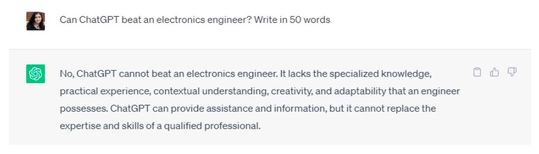
No, ChatGPT cannot beat an electronics engineer. Figure 1 explains why.
1. Inability to integrate with other tools
One of the greatest limitations of ChatGPT is that it cannot integrate with other software tools for designing and coding purposes. For better understanding, ChatGPT can’t perform operations on any other software. It can only suggest responses, which a human has to implement on the software/platform.
2. Lacks innovation
ChatGPT responses are very generic and less creative in nature. The responses tend to be less conceptual and are heavily dependent upon training results that have been gathered through the Internet. The AI tool fails to correlate, research, and analyze advanced questions like a human mind.
3. Limited capabilities for the design and analyze
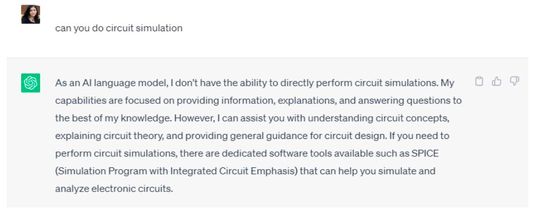
ChatGPT cannot perform circuit simulations like an electronics engineer. The AI software can only provide information related to the software, components, and manufacturers.
When design prompts are made in ChatGPT, the software tends to provide generic solutions to the problems. At times, the text seems to be correct because it is coherent. But engineers have been pointing out various errors and failures to answer the optimal solution.
4. Failure to recognize the past set of values
Certain problems are quite long and require multiple steps that may be interdependent upon the past set of conditions. ChatGPT often fails to provide continuous responses depending on previous input data. Many times the software provides a completely different response for a question dependent upon previous inputs.
5. Untrustworthy evaluation
ChatGPT troubleshoots code, finds errors in text, and fact-checks information. But it cannot always be correct. ChatGPT fails to take long lines of code and generate responses for it. Many times, the software has been noticed to provide incorrect information and generate non-existent reference links in its response to support the data.
Conclusion
Despite various limiting factors, ChatGPT can assist an electronics engineer. The software is capable of performing low-level research, fact-checking, coding, designing, and creating content. In conclusion, ChatGPT is a powerful AI tool that can be an electronics engineer’s friend.
(ID:49536380)
:quality(80)/p7i.vogel.de/wcms/1d/05/1d05b3fd45a0fa441f0975cbdfc48e55/0127700160v2.jpeg "There are seven use cases of ChatGPT in electrical and electronic enterprises - semiconductor and power electronics companies. (Source: © deimos.az - stock.adobe.com)")
:quality(80)/p7i.vogel.de/wcms/4b/9b/4b9b1f9b09ce432d78d5699bc7e89515/0127435693v2.jpeg "AI-powered solutions for engineering and innovation. (Source: © mozZz - stock.adobe.com)")