Ansys has announced it is integrating the NVIDIA Modulus AI framework into Ansys semiconductor simulation products to deliver AI functionality that significantly speeds up design optimization. This will enable engineers to create customized and generative AI surrogate models that accelerate design iterations and explore a larger design space. The technology integration will enhance the outcome for a wide range of products, including GPUs, HPC chips, AI chips, smartphone processors, and advanced analog integrated circuits.
Integration of NVIDIA Modulus AI framework with the Ansys SeaScape platform will enable engineers to easily build customized AI solutions that can improve designer productivity and quickly identify optimal design configurations. Read more about this here.
(Source: Werckmeister - stock.adobe.com)
NVIDIA Modulus is a physics-AI framework to train and deploy models that combine physics-based domain knowledge with simulation data, allowing users to create customized AI engines tailored to their needs. As AI gets integrated into computer-aided engineering workflows, it is important for users to have a seamless and integrated pipeline that allows data generated by solvers to flow to AI frameworks used to train models. Integrating NVIDIA Modulus framework into the Ansys SeaScape platform will enable customers to use high-fidelity data generated by Ansys tools to train their AI engines and then use the newly created engine for more robust design exploration.
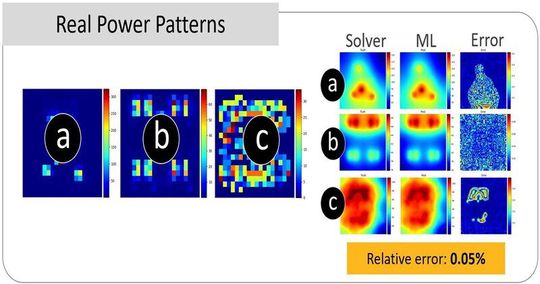
NVIDIA Modulus artificial intelligence framework will be integrated into the Ansys SeaScape cloud-optimized big data analytics platform for electronic design automation, which has demonstrated a speed-up of thermal simulation by over 100x.
(Source: ANSYS, Inc)
For example, designers can train their AI models in the integrated Modulus framework using their library of completed designs in Ansys RedHawk-SC. Once the AI is trained, it can be used to identify optimal designs based on desired specifications — such as size, power, and performance — in a fraction of the time. Ansys plans to add Modulus-created AI accelerators to its semiconductor solutions including RedHawk-SC, Totem-SC, PathFinder-SC, and RedHawk-SC Electrothermal for faster thermal simulation and easier power calculation. With this AI-enhanced process, Ansys and NVIDIA have demonstrated over 100x speed-up for thermal simulations.
"NVIDIA has been collaborating closely with Ansys as both a partner and a customer for many years," said John Lee, vice president and general manager of the semiconductor, electronics, and optics business unit at Ansys. "Ansys' advancements in semiconductor design solutions have been fueled and enabled by NVIDIA's powerful chips, and the collaboration continues to bring state-of-the-art EDA tools to our mutual customers."
"NVIDIA Modulus makes it easy to train and deploy AI models that are physics-informed and reflect real-world causality," said Tim Costa, senior director of CAE, EDA & quantum and HPC at NVIDIA. "The integration with Ansys simulation products for multiphysics semiconductor design are ideal applications for Modulus to enhance simulation speed and efficiently identify the best design solutions."
Follow us on LinkedIn
Have you enjoyed reading this article? Then follow us on LinkedIn and stay up-to-date with daily posts about the latest developments on the industry, products and applications, tools and software as well as research and development.
It goes without saying that we treat your personal data responsibly. Where we collect personal data from you, we process the data in compliance with the relevant data protection regulations. More detailed information is available in our privacy policy.
Consent to the use of data for advertising purposes
I consent to the use of my email address to send editorial newsletters by Mesago Messe Frankfurt GmbH, Rotebühlstr. 83-85, 70178 Stuttgart, Germany including all of its affiliates within the meaning of Section 15 et seq. AktG (‘Mesago’). I have viewed lists of each group of affiliates here for the Mesago. The content of the newsletter covers the products and services of all of the companies listed above including, for example, trade magazines and specialist books, events and exhibitions and event-related products and services, printed and digital media products and services such as additional (editorial) newsletters, competitions, lead campaigns, online and offline market research, technical web portals and e-learning courses. If my personal telephone number has also been collected, it may be used to send offers for the aforementioned products and services from the above companies, as well as for market research purposes. If I wish to access protected content online on portals of Mesago including its affiliates within the meaning of Section 15 et seq. AktG, I must register with additional data in order to access that content. In return for this free access to editorial content, my data may be used in line with this declaration of consent for the purposes described herein.
Right to withdraw consent
I am aware that I can withdraw this consent at any time with future effect. My withdrawal of consent does not affect the lawfulness of processing performed based on my consent before its withdrawal. If I wish to withdraw my consent, I can send an email to Mesago at privacy@mesago.com. If I no longer wish to receive individual newsletters to which I have subscribed, I can also click on the unsubscribe link at the bottom of a newsletter. I can find more information on my right to withdraw, how to exercise this right and the consequences of my withdrawal in the Privacy policyEditorial newsletters section.



:quality(80)/p7i.vogel.de/wcms/2f/f3/2ff3221bf7665de2d0acf83760bfd1fa/0130031523v2.jpeg "Wolfspeed presents a 300 mm silicon carbide technology platform designed to support advanced packaging and high-efficiency power delivery for AI data center infrastructure. (Source: Wolfspeed)")
:quality(80)/p7i.vogel.de/wcms/c3/16/c316e955a97f5d72d9678297b237b9e5/0129932858v2.jpeg "Left: the single-phase version of the SENTRON ECPD with RCM, right: a model of the future three-phase version of the SENTRON ECPD. (Source: Siemens)")
:quality(80)/p7i.vogel.de/wcms/ef/0a/ef0adb0acf793fe147cc27c21f6a7a67/0129954238v2.jpeg "Empower Semiconductor introduces embedded silicon capacitors designed to improve power delivery and stability in AI and high-performance computing processors. (symbolic image) (Source: © IF.arc - stock.adobe.com)")
:quality(80)/p7i.vogel.de/wcms/53/f9/53f9301dfc9292d02960f7996c79cc6e/0129927601v2.jpeg "Wolfspeed’s new 10 kV SiC MOSFET enables high-voltage power conversion for grid and industrial applications. (symbolic image) (Source: © CREATIVE- 3.4 - stock.adobe.com)")
:quality(80)/p7i.vogel.de/wcms/6e/cd/6ecd41d095d5111cf4ed37b714844487/0129930878v2.jpeg "PCIM Asia Shenzhen provides a platform for industry experts to present new developments in power electronics and electrification technologies. (symbolic image) (Source: © killykoon - stock.adobe.com)")
:quality(80)/p7i.vogel.de/wcms/02/c0/02c0e9722f70b1134dbf96fb59a9c73d/0129655179v2.jpeg "The PCIM Conference 2026 will take place from June 9-11, featuring discussions on power electronics trends, including GaN technology and AI applications. (symbolic image) (Source: © Elmira - stock.adobe.com)")
:quality(80)/p7i.vogel.de/wcms/cc/67/cc670ea2029cd2af5c641af70e1bf734/0129816392v4.jpeg "Fraunhofer IAF coordinates the EU SUPREME project to accelerate GaN and SiC power semiconductor innovation in Europe. (Source: Fraunhofer IAF)")
:quality(80)/p7i.vogel.de/wcms/ea/e6/eae6aee30071e67a5627027974437134/0129544613v2.jpeg "GlobalFoundries and Renesas strengthen their collaboration to support U.S.-based semiconductor production and supply chain resilience. (Source: © ronstik - stock.adobe.com)")
:quality(80)/p7i.vogel.de/wcms/23/1a/231a97643aa7fc3adf2704a6273756c3/0130030642v2.jpeg "Gallium nitride (GaN) power devices are increasingly challenging silicon MOSFETs in low-voltage power conversion by enabling higher efficiency and switching performance. (Source: © Sheraz - stock.adobe.com)")
:quality(80)/p7i.vogel.de/wcms/3c/4b/3c4bbc68dda65c7071b4376fb57423b0/0130030465v2.jpeg "Faraday’s laws explain the fundamental behavior of magnetic fields and electronic devices in dynamic use cases. The operation of transformers, wireless chargers, induction cookers, induction motors, magnetic levitating trains (MAGLEV Trains), electric violin, and many others depends upon Faraday’s laws. (Source: © Sheraz - stock.adobe.com)")
:quality(80)/p7i.vogel.de/wcms/b1/5e/b15ee02b0ba02db70cf61e37d66ad1d3/0129349127v2.jpeg "Vehicle-to-grid (V2G) chargers enable bidirectional energy flow, allowing electric vehicles to act as mobile energy storage systems that can both draw power from and feed power back into the grid. (Source: © medienvirus - stock.adobe.com)")
:quality(80)/p7i.vogel.de/wcms/26/d5/26d591cc340077026eac56a0e7564faf/0129949603v2.jpeg "Flexible: The solid silicone-based electrolyte is elastic, thereby compensating for the voids that form in solid-state batteries during charging and discharging. (Source: Empa)")
:quality(80)/p7i.vogel.de/wcms/be/c8/bec8d43fc0ee73414274be44608b2970/0129748903v2.jpeg "The Infiniium XR804KA real-time oscilloscope delivers faster response time, improved stability, and streamlined workflows for high-speed digital and compliance testing. (Source: Keysight)")
:quality(80)/p7i.vogel.de/wcms/23/ee/23ee4a97790d6009dbfd7d9577ffa723/0129220424v2.jpeg "The R&S FPL1044 with the new RTSA option makes 40 MHz real-time frequency analysis available up to 44 GHz. (Source: Rohde & Schwarz )")
:quality(80)/p7i.vogel.de/wcms/3c/d1/3cd1cacbceb792ba63727199c61ca434/0127801860v2.jpeg "Thanks to cloud technology, users can collaborate on projects from anywhere and always have access to the latest planning data. (Source: SIEMENS)")
:quality(80)/p7i.vogel.de/wcms/5a/a0/5aa0436498af618297961fd54ab36cdf/0126290792v2.jpeg "Siemens accelerates student-led semiconductor innovation across Europe’s leading technical universities through Cre8Ventures’ Open Higher Education Program developed in collaboration with Arm and University of Southampton (Source: Siemens Digital Industries Software)")
:fill(fff,0)/p7i.vogel.de/companies/63/c7/63c7da97be945/diotec.png "diotec (Diotec Semiconductor AG)")
:fill(fff,0)/p7i.vogel.de/companies/61/dc/61dc0e8c2e420/dspace-logo-1000px-220107.png "dspace-logo-1000px-220107 (dSPACE GmbH)")
:fill(fff,0)/p7i.vogel.de/companies/68/2c/682c3e2e9a195/logotype-rvb.jpeg "logotype-rvb (https://www.mersen.com/en)")

:quality(80):fill(efefef,0)/p7i.vogel.de/wcms/66/c5/66c5de0fac082/pcim-2024-keynote-prof--dr.jpeg "PCIM 2024_Keynote Prof. Dr. Rolf Hellinger_Cover (stock.adobe.com - putilov_denis)")
:quality(80)/p7i.vogel.de/wcms/e2/d6/e2d6eadc2e131f89909e587e7ff0f0c5/0126751999v2.jpeg "Between 2023 and 2025, the semiconductor industry experienced profound changes, propelled by AI innovations, with Nvidia's rapid ascent and industry-wide transformations redefining the landscape. (Source: © er - stock.adobe.com)")
:quality(80)/p7i.vogel.de/wcms/66/2b/662b15dc3b47c5b8a13b9064d54975ff/0123420521v2.jpeg "DeepSeek AI is an AI model based out of China. The hype around DeepSeek AI revolves around its lower training and computational costs. Learn more about this here. (Source: 沈军 贡 - stock.adobe.com)")