


:quality(80)/p7i.vogel.de/wcms/2f/f3/2ff3221bf7665de2d0acf83760bfd1fa/0130031523v2.jpeg "Wolfspeed presents a 300 mm silicon carbide technology platform designed to support advanced packaging and high-efficiency power delivery for AI data center infrastructure. (Source: Wolfspeed)")
:quality(80)/p7i.vogel.de/wcms/c3/16/c316e955a97f5d72d9678297b237b9e5/0129932858v2.jpeg "Left: the single-phase version of the SENTRON ECPD with RCM, right: a model of the future three-phase version of the SENTRON ECPD. (Source: Siemens)")
:quality(80)/p7i.vogel.de/wcms/ef/0a/ef0adb0acf793fe147cc27c21f6a7a67/0129954238v2.jpeg "Empower Semiconductor introduces embedded silicon capacitors designed to improve power delivery and stability in AI and high-performance computing processors. (symbolic image) (Source: © IF.arc - stock.adobe.com)")
:quality(80)/p7i.vogel.de/wcms/53/f9/53f9301dfc9292d02960f7996c79cc6e/0129927601v2.jpeg "Wolfspeed’s new 10 kV SiC MOSFET enables high-voltage power conversion for grid and industrial applications. (symbolic image) (Source: © CREATIVE- 3.4 - stock.adobe.com)")
:quality(80)/p7i.vogel.de/wcms/6e/cd/6ecd41d095d5111cf4ed37b714844487/0129930878v2.jpeg "PCIM Asia Shenzhen provides a platform for industry experts to present new developments in power electronics and electrification technologies. (symbolic image) (Source: © killykoon - stock.adobe.com)")
:quality(80)/p7i.vogel.de/wcms/02/c0/02c0e9722f70b1134dbf96fb59a9c73d/0129655179v2.jpeg "The PCIM Conference 2026 will take place from June 9-11, featuring discussions on power electronics trends, including GaN technology and AI applications. (symbolic image) (Source: © Elmira - stock.adobe.com)")
:quality(80)/p7i.vogel.de/wcms/cc/67/cc670ea2029cd2af5c641af70e1bf734/0129816392v4.jpeg "Fraunhofer IAF coordinates the EU SUPREME project to accelerate GaN and SiC power semiconductor innovation in Europe. (Source: Fraunhofer IAF)")
:quality(80)/p7i.vogel.de/wcms/ea/e6/eae6aee30071e67a5627027974437134/0129544613v2.jpeg "GlobalFoundries and Renesas strengthen their collaboration to support U.S.-based semiconductor production and supply chain resilience. (Source: © ronstik - stock.adobe.com)")
:quality(80)/p7i.vogel.de/wcms/b1/5e/b15ee02b0ba02db70cf61e37d66ad1d3/0129349127v2.jpeg "Vehicle-to-grid (V2G) chargers enable bidirectional energy flow, allowing electric vehicles to act as mobile energy storage systems that can both draw power from and feed power back into the grid. (Source: © medienvirus - stock.adobe.com)")
:quality(80)/p7i.vogel.de/wcms/26/d5/26d591cc340077026eac56a0e7564faf/0129949603v2.jpeg "Flexible: The solid silicone-based electrolyte is elastic, thereby compensating for the voids that form in solid-state batteries during charging and discharging. (Source: Empa)")
:quality(80)/p7i.vogel.de/wcms/4d/e0/4de02f76a37cbb3df30dd231de589c8e/0128866890v2.jpeg "Both legacy and vGaN show higher carrier mobility and band gap energies compared to other power semiconductors. (Source: © phonlamaiphoto - stock.adobe.com)")
:quality(80)/p7i.vogel.de/wcms/18/0b/180b7b63afc91e523592d8a5ce161c96/0129847487v2.jpeg "InGaAs-based photodetectors enable sensitive and fast detection in the short-wave infrared spectrum for modern sensing and communication applications. (Source: © VITALII - stock.adobe.com)")
:quality(80)/p7i.vogel.de/wcms/be/c8/bec8d43fc0ee73414274be44608b2970/0129748903v2.jpeg "The Infiniium XR804KA real-time oscilloscope delivers faster response time, improved stability, and streamlined workflows for high-speed digital and compliance testing. (Source: Keysight)")
:quality(80)/p7i.vogel.de/wcms/23/ee/23ee4a97790d6009dbfd7d9577ffa723/0129220424v2.jpeg "The R&S FPL1044 with the new RTSA option makes 40 MHz real-time frequency analysis available up to 44 GHz. (Source: Rohde & Schwarz )")
:quality(80)/p7i.vogel.de/wcms/3c/d1/3cd1cacbceb792ba63727199c61ca434/0127801860v2.jpeg "Thanks to cloud technology, users can collaborate on projects from anywhere and always have access to the latest planning data. (Source: SIEMENS)")
:quality(80)/p7i.vogel.de/wcms/5a/a0/5aa0436498af618297961fd54ab36cdf/0126290792v2.jpeg "Siemens accelerates student-led semiconductor innovation across Europe’s leading technical universities through Cre8Ventures’ Open Higher Education Program developed in collaboration with Arm and University of Southampton (Source: Siemens Digital Industries Software)")
THERMAL MANAGEMENT 3D-printed heat sinks for chips and circuit boards in data centers
Sponsored by
:fill(fff,0)/p7i.vogel.de/companies/68/c2/68c2b622b43e1/logo.jpeg "logo (IQ Evolution GmbH)")
3D-printed chip and board coolers open up considerable efficiency potential and save space and material. IQ-Evolution is now bringing the technology, which has already proven itself in automotive electronics, to the data center market.
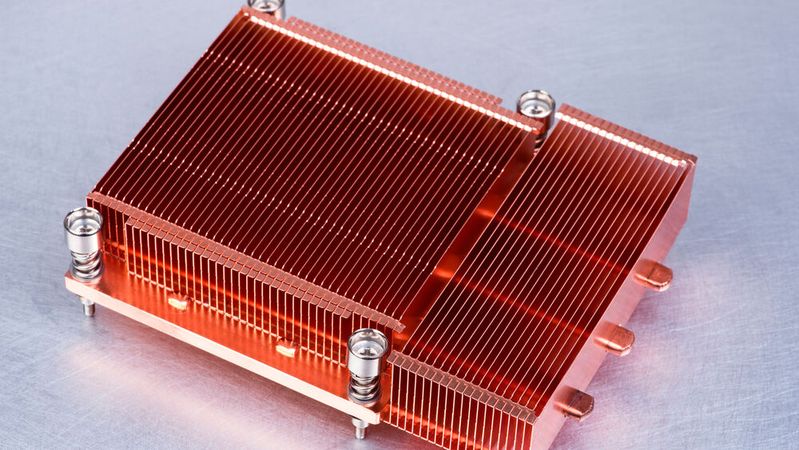
According to the Borderstep Institute, data centers in Germany will consume almost 18 billion kWh in 2022 - and the trend is rising. Almost all of this electricity is converted into waste heat. It would therefore make sense to use data center waste heat. It is now also required by law in the Energy Efficiency Act (ENEfG).
Liquid cooling is necessary for computing power of 30 kW or more per rack, which is quite common in the AI environment. It delivers higher waste heat temperatures with more efficient heat dissipation, which simplifies the feeding of waste heat into secondary use circuits, such as district heating networks.
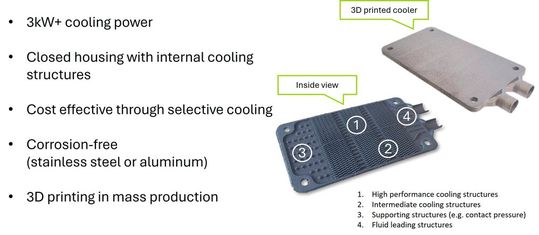
3D metall printing (LPBF)
Recently direct chip cooling is used. Heat sinks are a key component of directly liquid-cooled chips and circuit boards. They are applied directly to the components to be cooled. A water/glycol mixture flows through them and transports the waste heat away.
A relatively new production method for heat sinks that has been further developed and used by IQ Evolution is the 3D printing process Laser Power Bed Fusion (LPBF). The heat sinks produced in this way have already proven themselves in the automotive industry. The requirements for heat sinks are particularly high there.
LPBF produces burr-free and seamless heat sinks in any complex shape and from any material. During printing, powder is applied thinly and flatly to the work table and selectively laser-exposed. During exposure, the material melts and solidifies again in the desired shape. The work table then moves down 20 micrometers and the cycle is repeated.
For small formats, several heat sinks are produced in one print pass. In series production, several printing machines can be connected in parallel so that it can be scaled up quickly.
More efficiency, less space required
“We are convinced that our printed heat sinks and the associated properties can also bring significant benefits to data centers,” says Dr. Thomas Ebert, Managing Director of IQ Evolution. “That's why we are now also addressing the data center market.”
Because the heat sinks fit snugly against the chips, they transfer heat particularly effectively. The process also produces virtually no production waste. The thin wall thicknesses of sometimes only 150 micrometers also save material. Heat sinks can be designed to be more efficient at the hotspots of the structures to be cooled, such as the cores of multiprocessors, and more economical in other areas. The pressure resistance is still 60 bar.
The extremely flat shape and the lack of fans on the chip also save space in the rack. An example: The AMD Rizen Threadripper Pro gaming processor fits on just one height unit with a heatsink from IQ Evolution with greater cooling capacity - otherwise it takes up two. In terms of price, the heat sinks are comparable with other manufacturers despite their more complex shape and performance.
IQ Evolution is already negotiating with well-known integrators and OEM customers in the data center sector.
(ID:50233863)
:quality(80)/p7i.vogel.de/wcms/9a/af/9aafa5ad3d3d900a6e22adf6d06a9bf5/0126877798v2.jpeg "The image shows Data Centers optimized with thermal management- (Source: © Mariya - stock.adobe.com)")
:quality(80)/p7i.vogel.de/wcms/25/a5/25a5f03b687b18a3dbff3e43b16c9075/0126765129v2.jpeg "Data centers are shifting towards advanced cooling methods, including liquid cooling and AI, to efficiently manage escalating energy demands and heat from AI technologies. (Source: © ki - stock.adobe.com)")