


:quality(80)/p7i.vogel.de/wcms/2f/f3/2ff3221bf7665de2d0acf83760bfd1fa/0130031523v2.jpeg "Wolfspeed presents a 300 mm silicon carbide technology platform designed to support advanced packaging and high-efficiency power delivery for AI data center infrastructure. (Source: Wolfspeed)")
:quality(80)/p7i.vogel.de/wcms/c3/16/c316e955a97f5d72d9678297b237b9e5/0129932858v2.jpeg "Left: the single-phase version of the SENTRON ECPD with RCM, right: a model of the future three-phase version of the SENTRON ECPD. (Source: Siemens)")
:quality(80)/p7i.vogel.de/wcms/ef/0a/ef0adb0acf793fe147cc27c21f6a7a67/0129954238v2.jpeg "Empower Semiconductor introduces embedded silicon capacitors designed to improve power delivery and stability in AI and high-performance computing processors. (symbolic image) (Source: © IF.arc - stock.adobe.com)")
:quality(80)/p7i.vogel.de/wcms/53/f9/53f9301dfc9292d02960f7996c79cc6e/0129927601v2.jpeg "Wolfspeed’s new 10 kV SiC MOSFET enables high-voltage power conversion for grid and industrial applications. (symbolic image) (Source: © CREATIVE- 3.4 - stock.adobe.com)")
:quality(80)/p7i.vogel.de/wcms/6e/cd/6ecd41d095d5111cf4ed37b714844487/0129930878v2.jpeg "PCIM Asia Shenzhen provides a platform for industry experts to present new developments in power electronics and electrification technologies. (symbolic image) (Source: © killykoon - stock.adobe.com)")
:quality(80)/p7i.vogel.de/wcms/02/c0/02c0e9722f70b1134dbf96fb59a9c73d/0129655179v2.jpeg "The PCIM Conference 2026 will take place from June 9-11, featuring discussions on power electronics trends, including GaN technology and AI applications. (symbolic image) (Source: © Elmira - stock.adobe.com)")
:quality(80)/p7i.vogel.de/wcms/cc/67/cc670ea2029cd2af5c641af70e1bf734/0129816392v4.jpeg "Fraunhofer IAF coordinates the EU SUPREME project to accelerate GaN and SiC power semiconductor innovation in Europe. (Source: Fraunhofer IAF)")
:quality(80)/p7i.vogel.de/wcms/ea/e6/eae6aee30071e67a5627027974437134/0129544613v2.jpeg "GlobalFoundries and Renesas strengthen their collaboration to support U.S.-based semiconductor production and supply chain resilience. (Source: © ronstik - stock.adobe.com)")
:quality(80)/p7i.vogel.de/wcms/b1/5e/b15ee02b0ba02db70cf61e37d66ad1d3/0129349127v2.jpeg "Vehicle-to-grid (V2G) chargers enable bidirectional energy flow, allowing electric vehicles to act as mobile energy storage systems that can both draw power from and feed power back into the grid. (Source: © medienvirus - stock.adobe.com)")
:quality(80)/p7i.vogel.de/wcms/26/d5/26d591cc340077026eac56a0e7564faf/0129949603v2.jpeg "Flexible: The solid silicone-based electrolyte is elastic, thereby compensating for the voids that form in solid-state batteries during charging and discharging. (Source: Empa)")
:quality(80)/p7i.vogel.de/wcms/4d/e0/4de02f76a37cbb3df30dd231de589c8e/0128866890v2.jpeg "Both legacy and vGaN show higher carrier mobility and band gap energies compared to other power semiconductors. (Source: © phonlamaiphoto - stock.adobe.com)")
:quality(80)/p7i.vogel.de/wcms/18/0b/180b7b63afc91e523592d8a5ce161c96/0129847487v2.jpeg "InGaAs-based photodetectors enable sensitive and fast detection in the short-wave infrared spectrum for modern sensing and communication applications. (Source: © VITALII - stock.adobe.com)")
:quality(80)/p7i.vogel.de/wcms/be/c8/bec8d43fc0ee73414274be44608b2970/0129748903v2.jpeg "The Infiniium XR804KA real-time oscilloscope delivers faster response time, improved stability, and streamlined workflows for high-speed digital and compliance testing. (Source: Keysight)")
:quality(80)/p7i.vogel.de/wcms/23/ee/23ee4a97790d6009dbfd7d9577ffa723/0129220424v2.jpeg "The R&S FPL1044 with the new RTSA option makes 40 MHz real-time frequency analysis available up to 44 GHz. (Source: Rohde & Schwarz )")
:quality(80)/p7i.vogel.de/wcms/3c/d1/3cd1cacbceb792ba63727199c61ca434/0127801860v2.jpeg "Thanks to cloud technology, users can collaborate on projects from anywhere and always have access to the latest planning data. (Source: SIEMENS)")
:quality(80)/p7i.vogel.de/wcms/5a/a0/5aa0436498af618297961fd54ab36cdf/0126290792v2.jpeg "Siemens accelerates student-led semiconductor innovation across Europe’s leading technical universities through Cre8Ventures’ Open Higher Education Program developed in collaboration with Arm and University of Southampton (Source: Siemens Digital Industries Software)")
ELECTRIC VEHICLES V2G bidirectional chargers
Related Vendors
:fill(fff,0)/p7i.vogel.de/companies/60/7e/607ec89d5d9b5/white-frame.jpg "white frame.jpg (www.rohm.com)")
:fill(fff,0)/p7i.vogel.de/companies/61/dc/61dc0e8c2e420/dspace-logo-1000px-220107.png "dspace-logo-1000px-220107 (dSPACE GmbH)")
:fill(fff,0)/p7i.vogel.de/companies/68/00/6800eb0040fb9/cobalt-vertical-aligned-bold.png "cobalt-vertical-aligned-bold (CISSOID SA)")
The job of a gas station or tankstelle has always been refuelling vehicles and sending them back to the road. The energy flow of non-renewables is unidirectional. For electric vehicle charging, scientists and researchers reimagined charging stations. Manufacturers moved EV chargers beyond charging, turning vehicles into energy storage systems on wheels.
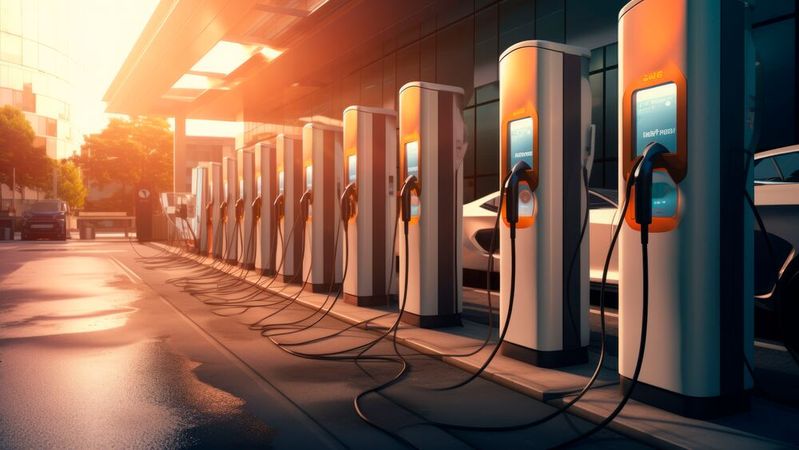
V2G bidirectional chargers explained
Vehicle-to-grid chargers, commonly known as V2G chargers, are bidirectional electric vehicle supply equipment (EVSE) that perform their normal operation of charging EVs through the grid, but can also transfer power back to the grid. These chargers have an internal power conversion system made from SiC/GaN.
Conventional EV chargers take AC electricity from the grid and convert it into DC for charging the battery. Some advanced, but legacy EV chargers, known as smart chargers or V1G chargers, control charging and discharging processes based on demand. The charging power could be increased or decreased.
:quality(80)/p7i.vogel.de/wcms/95/1a/951ad4e3e5fea686d47dcbb4fc4fc9a8/0128551547v2.jpeg "Wolfspeed’s silicon carbide MOSFETs power Toyota’s battery electric vehicle onboard chargers, enabling high-efficiency and reliable EV performance. (Source: © hd3dsh - stock.adobe.com)")
EV POWER
Wolfspeed powers Toyota’s electric vehicle platforms
V2G chargers convert AC to DC to charge the EV battery and DC from the EV battery to AC during the discharging process for the grid. V2G chargers turn EVs into temporary, mobile, and distributed energy resources (DERs) for grid stabilization and energy-saving goals.
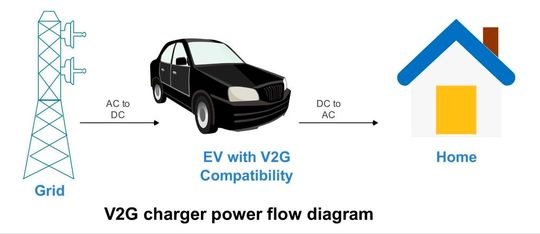
V2G chargers show demand-response capabilities in real-time applications. They are a type of V2X chargers - vehicle-to-everything. It means that electric vehicles can charge almost anything as a load. In addition to V2G chargers, some use cases include the following:
- Vehicle-to-home (V2H): V2H chargers can support home appliances during blackouts. All fans, refrigerators, heaters, dryers, air conditioners, and ovens can remain functional during power outages.
- Vehicle-to-home (V2H): V2B chargers, when connected with large-scale storage in microgrids, can contribute to charging solutions for an entire commercial or residential building.
- Vehicle-to-load (V2L): V2L chargers can make EVs function like a giant mobile power bank. Such EVs have built-in outlets to charge devices, including mobile phones, laptops, and even drills.
Why use V2G bidirectional chargers?
Commercially available V2G chargers are DC chargers with a maximum charging power of around 11 kilowatt (common) and 15 kilowatt. ISO 15118 is the international standard for plug & charge functionality of EV charging, which V2G chargers adhere to. V2G chargers can support a single building, microgrid, wind farm, solar panel system, and diesel generator.
:quality(80):fill(efefef,0)/images.vogel.de/vogelonline/bdb/1789200/1789252/original.jpg "Whitepaper Cover: finepower")
When EVs are not in use, they can still add to cost-cutting benefits. Modern EVs from Nissan, Hyundai, Mercedes, Honda, and Tata Motors support V2G chargers. Many EV companies, such as Ford and Tesla, are on the verge of adopting and commercializing V2G chargers.
The key drivers of V2G adoption are electrification, energy efficiency, decarbonization, and climate change mitigation. In addition, EV batteries are among the affordable energy storage technologies because they don’t need complicated and costly hardware to function.
Grid balancing: V2G-compatible EVs send power back to the grid collectively, handling momentary consumption spikes and demands. Instead of relying on expensive reserve power plants, utility companies can use parked EVs as distributed, cost-effective batteries to draw a small amount of power during peak hours.
Load management: Modern V2G charging manufacturers have enabled smart charging solutions based on dynamic load management (DLM). EV chargers constantly draw more power than needed. DLM defines limits and distributes electricity across multiple chargers and devices in real-time.
Backup: V2G chargers function as mobile storage that can be taken on-site during unexpected power outages. Renewable energy-powered grids generate excess energy during peak hours, such as afternoons for solar panels or windy days for wind farms. Excess energy may cause congestion, preventing energy from reaching the destination. V2G chargers can either stop charging or feed power locally.
Reduced investments: V2G chargers can eliminate the need to invest in and own complex grid infrastructure, which might cost millions of dollars in CapEx and OpEx. V2G chargers range from USD 1500 to USD 13,000 for an EVSE bundle. During peak hours, utility companies perform energy curtailment. They often discharge batteries during this time to keep loads operational.
Independent charging: In some countries with lesser EV adoption, charging stations can be located at a significant distance. With the help of V2G charging solutions, EV customers become less dependent on charging stations.
Remote operation: V2G chargers are suitable for at-home private charging. Buildings use a time-of-use (TOU) strategy to reduce electricity costs by charging EV batteries during off-peak hours at a low price. If cars are not being charged, electricity supports other lights and appliances at home.
Consumer benefit: EV and V2G charger owners can make extra money for charging the grid based on the fleet-as-a-service model. A subsequent utility partner program, depending upon the nation and region, pays users for discharging batteries to the grid.
Manufacturer’s benefit: The V2X bidirectional charging market (V2G, V2H, and V2L) is valued at USD70 million. EV and charger manufacturers, especially original equipment manufacturers (OEMs), can make more profits from V2G charging functionalities and support. OEM adoption of bidirectional hardware is at an all-time high, according to a report.
References
- https://www.energy.gov/femp/bidirectional-charging-and-electric-vehicles-mobile-storage
- https://www.virta.global/vehicle-to-grid-v2g
- https://www.cleanenergyreviews.info/blog/bidirectional-ev-chargers-review
- https://www.marketsandmarkets.com/Market-Reports/bidirectional-charging-market-64700205.html
(ID:50704728)
:quality(80)/p7i.vogel.de/wcms/6e/e5/6ee5ad1dc45fd69a5a5718147605850a/0129347492v2.jpeg "This article introduces the concept of megawatt-hour battery storage systems.
(Source: © malp - stock.adobe.com)")
:quality(80)/p7i.vogel.de/wcms/4d/39/4d390c935fec4cd94dab8d1ec43fc67d/0128521086v2.jpeg "Symbolic image: A retrofitted EV charges wirelessly via the ground-embedded coil, with the charging process starting automatically once the vehicle is positioned correctly. (Source: © Johnnii - stock.adobe.com)")